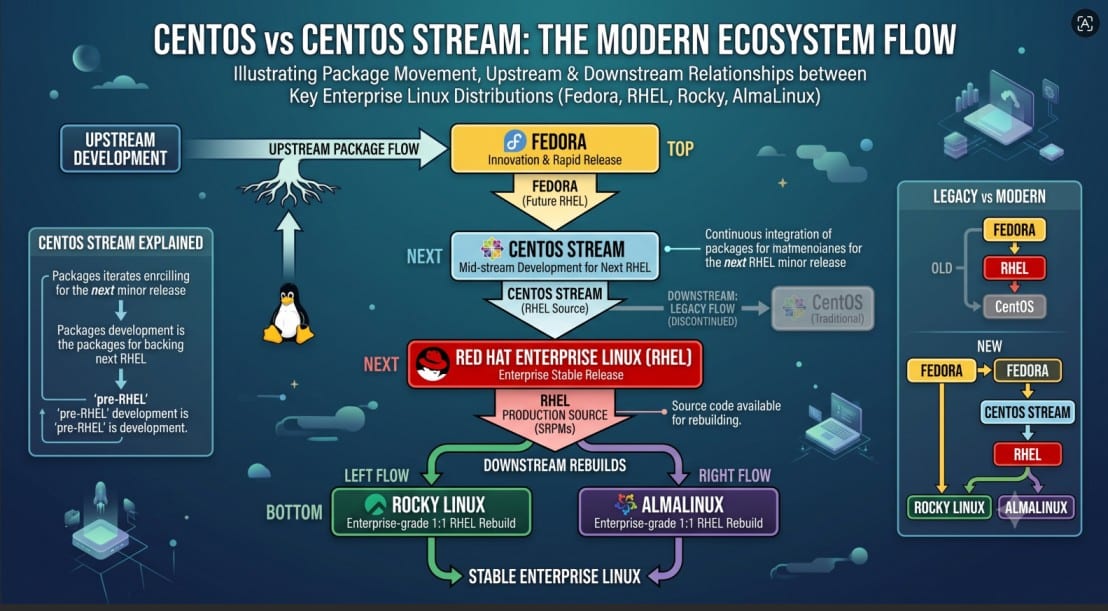
CentOS vs CentOS Stream: What Actually Changed
CentOS vs CentOS Stream: What Actually Happened, and What to Install in 2026
CentOS vs CentOS Stream is still one of the most confusing questions in the Linux world, five years after the change that caused it. Is CentOS dead? Is Stream the same thing with a new name? Why is every tutorial from before 2021 suddenly wrong? And what should you actually install today?
Short answers: yes, CentOS Linux as you knew it is dead; no, Stream is not the same thing; and what you should install in 2026 is probably neither — it’s Rocky Linux or AlmaLinux. Here’s the whole story, briefly, including the plot twist most articles miss.
A Quick History: Where CentOS Came From
CentOS — the Community Enterprise Operating System — was born in 2004 when Gregory Kurtzer and a community of volunteers did something perfectly legal and slightly cheeky: they took the source code of Red Hat Enterprise Linux (which Red Hat must publish, because it’s open source), stripped out Red Hat’s trademarks and branding, and rebuilt it into a free operating system.
The result was gold for sysadmins: an OS that behaved identically to RHEL, bug-for-bug, without the subscription cost. Companies ran it on millions of servers. Training labs ran it because RHEL skills transferred one-to-one. It became the default answer to “free enterprise Linux.”
Red Hat noticed, and in 2014 brought the CentOS project in-house — sponsoring it officially. For six more years the arrangement held, and the flow of code looked like this:
Fedora → RHEL → CentOS Linux
Fedora moves first. The parts that settle become RHEL. CentOS rebuilt RHEL for free. CentOS sat downstream of RHEL — it received finished, enterprise-tested code.
What Changed: The December 2020 Announcement
In December 2020, Red Hat announced it was ending CentOS Linux and shifting all effort to CentOS Stream — and the crucial change is where Stream sits in that pipeline:
Fedora → CentOS Stream → RHEL
Stream moved upstream of RHEL. Instead of receiving code after RHEL ships it, Stream now receives code before it lands in the next RHEL minor release. Stream is, in Red Hat’s own framing, a preview of what RHEL is about to become — a continuously updated development branch, not a rebuild of a finished product.
The timeline that followed was brutal for anyone running CentOS in production: CentOS Linux 8 support ended December 31, 2021 (cut short by eight years from its original schedule), and CentOS Linux 7 — the last survivor — reached end of life on June 30, 2024. Since that date, CentOS Linux no longer exists as a supported operating system. Only CentOS Stream carries the name forward, with Stream 9 and the current Stream 10 actively maintained.
CentOS vs CentOS Stream: The Actual Difference
The name survived; the role reversed. Side by side:
| CentOS Linux (dead) | CentOS Stream (current) | |
|---|---|---|
| Position | Downstream of RHEL | Upstream of RHEL |
| What it was/is | 1:1 rebuild of released RHEL | Rolling preview of the next RHEL |
| Stability promise | Identical to RHEL, enterprise-tested | Generally solid, but changes land before RHEL ships them |
| Updates | Fixed point releases (7.9, 8.5…) | Continuous stream, no minor versions |
| Production parity with RHEL | Exact | Approximate — always slightly ahead |
| Status in 2026 | EOL (7 ended June 2024) | Active — Stream 9 and Stream 10 |
Is Stream bad? No — that’s the overcorrection people made in 2021. Stream is a genuinely usable, mostly stable OS, and it’s exactly the right choice if you want to see where RHEL is heading or contribute to it. What Stream is not is what CentOS Linux was: a drop-in, bug-for-bug free RHEL. If your reason for choosing CentOS was “identical to what my company runs in production,” Stream no longer gives you that.
The Plot Twist: CentOS’s Founder Built Its Successor
Here’s the detail that makes this story satisfying. Within days of the 2020 announcement, Gregory Kurtzer — the same person who founded CentOS in 2004 — announced a new project to do exactly what the original CentOS did: rebuild RHEL, 1:1, free. He named it Rocky Linux, after Rocky McGaugh, a late co-founder of the original CentOS project.
At the same time, CloudLinux launched AlmaLinux with the same mission. Both are mature, well-governed, and production-proven in 2026; both fill precisely the hole CentOS Linux left. Rocky aims for bug-for-bug RHEL compatibility; AlmaLinux targets full application-level compatibility (a distinction that matters to almost nobody in practice — pick either).
So the ecosystem healed itself: the “free RHEL clone” role CentOS abandoned didn’t disappear, it just changed names.
So What Should You Install in 2026?
Depends entirely on why you’re asking:
Learning Linux for a sysadmin or cloud job, or practicing for the RHCSA? → Rocky Linux or AlmaLinux. They give you the exact RHEL environment that dominates enterprise server rooms, for free, forever. This is what I use in the Linux roadmap for beginners and what our upcoming installation guides on this site are built on. If an older course you’re following says “install CentOS,” Rocky/Alma is the modern translation — the installer and every command are effectively identical.
Want to track or contribute to RHEL’s development? → CentOS Stream. That’s its actual purpose now, and it does it well.
Running actual production and need vendor support? → RHEL itself. And an underused fact: Red Hat’s free Developer Subscription gives individuals genuine RHEL at no cost on up to 16 systems — arguably the best-kept secret in this whole saga, and perfectly fine for a home lab too.
Still running old CentOS Linux 7/8 servers? → Migrate, urgently — you’ve had no security patches since mid-2024. Both Rocky and AlmaLinux publish one-command migration scripts that convert a CentOS system in place.
Names changed; chmod didn’t
CentOS vs CentOS Stream isn’t really a versus — they’re different products sharing a name. CentOS Linux (the free RHEL clone) is dead; CentOS Stream (the RHEL preview) is alive and serves a different job; and the spiritual successors to what everyone actually loved about CentOS are Rocky Linux and AlmaLinux, one of them built by CentOS’s own founder.
If you’re here because conflicting tutorials left you unsure what to install: install Rocky or Alma, mentally substitute them anywhere an older course says “CentOS,” and get back to learning the fundamentals that actually matter — the distribution drama changes; chmod does not.
FAQ
Is CentOS dead in 2026?
CentOS Linux — the free 1:1 RHEL rebuild — is dead: CentOS 8 support ended in December 2021 and CentOS 7 reached end of life on June 30, 2024. CentOS Stream continues as a separate, actively maintained product with a different role.
Is CentOS Stream the same as CentOS?
No. Classic CentOS was built from released RHEL code (downstream). Stream feeds code into the next RHEL release (upstream). Stream previews RHEL; classic CentOS mirrored it.
What replaced CentOS?
Rocky Linux and AlmaLinux — free, community-built 1:1 rebuilds of RHEL, created in direct response to CentOS Linux’s discontinuation. Rocky Linux was founded by Gregory Kurtzer, the original founder of CentOS.
Is CentOS Stream stable enough for production?
It’s more stable than its reputation suggests — it’s the staging ground for RHEL, not a nightly build. But it lacks minor versions, changes ahead of RHEL, and offers no vendor support, so most production environments choose Rocky, Alma, or RHEL itself instead.
Should I learn CentOS Stream or Rocky Linux for the RHCSA?
Rocky Linux or AlmaLinux — they match the released RHEL versions the exam targets. Stream runs slightly ahead of RHEL, which is exactly what you don’t want when practicing for a version-specific certification.
Can I still download CentOS 7?
Archived images exist, but you shouldn’t use them: no security updates have been issued since June 2024. For anything new, use Rocky Linux, AlmaLinux, CentOS Stream, or RHEL’s free developer subscription.