12 Examples of Linux in Everyday Life (You Use It Daily)
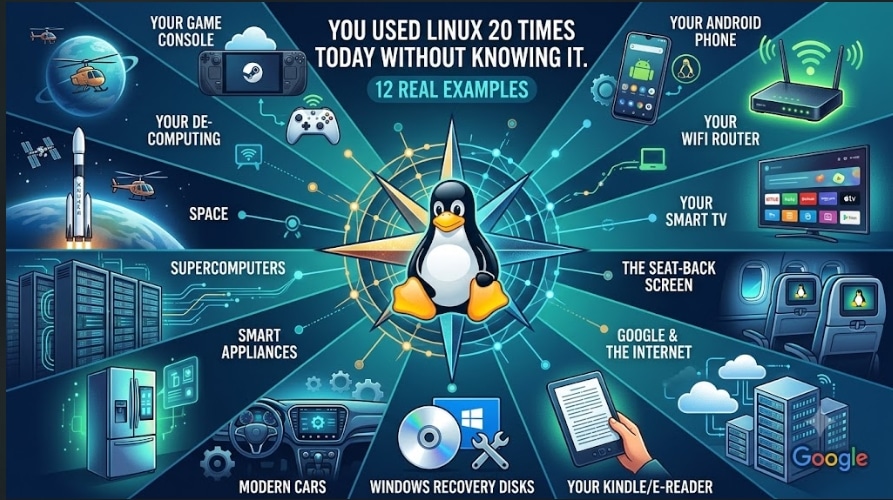
You Used Linux 20 Times Today Without Knowing It: 12 Real Examples
Ask a room full of people whether they’ve ever used Linux and most hands stay down. “Isn’t that the hacker thing with the black terminal?”
Here’s the fun part: everyone in that room used Linux before breakfast. They woke up to a Linux alarm clock, checked messages on a Linux phone, streamed music through a Linux router, and if they Googled anything at all, a building full of Linux servers answered them.
Windows won the desktop, so people assume it won computing. It didn’t. Linux quietly won everything else — and once you see the pattern, you can’t unsee it. Here are twelve places Linux is hiding in your everyday life, including a few that genuinely surprised me even after years of working with it.
1. Your Android phone
The big one. Android is built on the Linux kernel — every Android phone, which means roughly 7 out of every 10 smartphones on the planet, is a Linux device. When your phone manages memory, schedules apps, or talks to the wifi chip, that’s the Linux kernel doing the work underneath Google’s interface. If you own an Android phone, you’re not a potential Linux user. You’re a Linux user with years of experience.
2. Your wifi router
That little box blinking in the corner almost certainly runs an embedded Linux. The web page you open at 192.168.1.1 to change your wifi password? That’s a web application served by a tiny Linux system. Enthusiasts even replace the manufacturer’s firmware with full open-source Linux distributions like OpenWrt to unlock features the vendor never shipped.
3. Your smart TV
LG TVs run webOS. Samsung TVs run Tizen. Android TV and Google TV are, well, Android. All of them are Linux underneath. I can vouch for this one personally — I’ve built and sideloaded apps for LG webOS signage displays, and under the polished interface it’s a familiar Linux environment you can even debug remotely with Chrome DevTools.
4. The seat-back screen on your flight
Those in-flight entertainment systems from Panasonic and Thales that let you watch movies at 35,000 feet? Embedded Linux platforms. Next time your seat-back screen crashes and reboots, watch closely — passengers regularly photograph Tux the penguin and Linux boot logs scrolling by. There’s something poetic about spotting a kernel panic somewhere over the Arabian Sea.
5. Google, and most of the internet
Every Google search you run is answered by Linux servers — Google runs its infrastructure on a customised Linux and is one of the kernel’s major contributors. And it’s not just Google: the majority of all web servers on the internet run Linux, which means most websites you visited today — including this one — were delivered to you by a Linux machine.
6. Your Kindle and other e-readers
Amazon’s Kindle runs embedded Linux. That week-long battery life while you read three novels? A stripped-down Linux system managing an e-ink display with extreme efficiency.
7. Windows recovery disks (yes, really)
My favourite irony in all of computing: when Windows breaks badly enough, many of the rescue tools used to fix it — partition editors like GParted, recovery environments like SystemRescue, disk cloners like Clonezilla — are bootable Linux systems. Linux regularly gets called in to save Windows. The reverse almost never happens.
8. Modern cars — including the self-driving kind
Tesla’s infotainment system runs on Linux. So do the dashboards and driver-assistance platforms of dozens of other manufacturers through Automotive Grade Linux, a project backed by Toyota, Honda, and others. The autonomous-driving systems being tested today overwhelmingly run their perception and decision software on Linux, because when a car needs to process camera feeds in real time, you want an OS you can strip down and control completely.
9. Smart appliances
Touchscreen refrigerators, washing machines with wifi, robot vacuums mapping your living room — embedded Linux, almost across the board. When an appliance manufacturer needs a free, customisable, stable OS that runs on cheap hardware, there’s really only one answer, which is why your vacuum cleaner now technically has an uptime.
10. Supercomputers — all of them
This one isn’t “most” or “many”: 100% of the TOP500 supercomputers on Earth run Linux. Every single machine on the list, since 2017. When scientists model climate systems, fold proteins, or simulate nuclear physics, Linux is the only operating system trusted at that scale.
11. Space
The International Space Station’s laptops run Debian Linux — NASA migrated them from Windows years ago, citing stability. SpaceX’s Falcon 9 rockets fly on Linux. And in 2021, the Ingenuity helicopter flew on Mars running Linux — the first powered flight on another planet, piloted by the same kernel family that runs your wifi router.
12. Your game console (probably)
Valve’s Steam Deck runs SteamOS, a full Arch Linux system that plays thousands of Windows games through a compatibility layer. PlayStation’s system software has BSD roots rather than Linux, but Nintendo, Valve, and the entire cloud-gaming backend world lean heavily on Linux servers to stream games to your screen.
The pattern behind all of this
Notice what these twelve examples have in common. Nobody chose Linux because it’s trendy. Engineers chose it because it’s free, endlessly customisable, runs on anything from a lightbulb to a supercomputer, and stays up for years without a reboot. Those same properties are why companies keep hiring people who understand it — the demand side of this story is covered in my honest take on whether Linux is worth learning in 2026.
And here’s the practical takeaway if you’re at the start of your IT journey: Linux isn’t some niche skill for a niche system. It’s the operating system of everything except the desktop — phones, servers, cloud, cars, space. Learning it isn’t optional for an infrastructure career; it’s the entry ticket.
The gap between “I use Linux devices all day” and “I can administer Linux systems” is about 12 weeks of structured practice. I’ve laid out exactly what to learn and in what order in the step-by-step Linux roadmap for beginners — start there, and the next time your flight’s seat-back screen reboots, you’ll be the one person on the plane who can read the boot log.
FAQ
Is Android really Linux?
Yes – Android is built on the Linux kernel, with Google’s own user interface and app framework on top. It doesn’t include the GNU tools of a desktop distribution, which is why some purists say “Linux-based” rather than “Linux,” but the kernel managing your phone’s hardware is genuinely Linux.
Why do so many devices use Linux instead of Windows?
Cost and control. Linux is free (no per-device licence fee), open source (manufacturers can strip it down to exactly what a device needs), and famously stable. For a company shipping ten million routers, those three properties are decisive.
Does Google run on Linux?
Yes. Google’s server infrastructure runs on a customised internal Linux, and Google is a significant contributor to Linux kernel development. ChromeOS and Android, both Google products, are also Linux-based.
What percentage of servers run Linux?
The strong majority of web-facing servers and cloud workloads run Linux, and it currently accounts for essentially all of the TOP500 supercomputers. Exact figures vary by survey, but on the server side Linux’s dominance isn’t in dispute.
If I use Android, do I already know Linux?
You know how to use a Linux-based device, which is a different skill from administering Linux – the command line, permissions, services, and storage. The good news: the administration side is very learnable, and 2–3 months of structured practice gets most beginners to entry-level job readiness.
Sources
- TOP500: operating system family statistics, for the Linux-on-supercomputers figure