SysAdmin to DevOps in 2026: A Practical Transition Roadmap
You have been SSHing into boxes for years. You know why that one crontab fails. You have fixed NFS mounts with incomplete docs and a stubborn streak. Then someone in standup says “just throw it in the pipeline” and you feel behind.
That gap — solid sysadmin craft versus DevOps fluency — is what this roadmap closes. Not a certification shopping list. Not “learn Kubernetes in a weekend.” The order that actually sticks. I have watched juniors jump straight into Helm and drown. I have also watched quiet Linux admins become the strongest DevOps people in the room because they already understood failure modes. You likely already have the hard part. We sequence the tools.
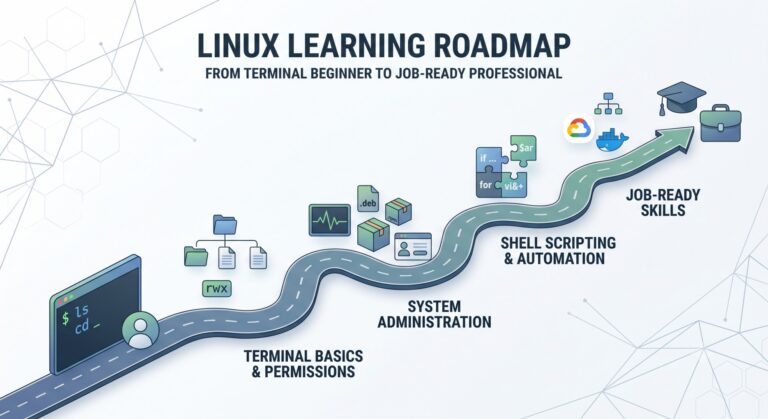
If Linux fundamentals are still shaky, fix that first: Linux roadmap for beginners and the honest take on whether Linux is worth learning in 2026.
Why transitions stall (owned patterns)
These are not abstract “anti-patterns.” They are tickets I have reviewed:
- Tool hoarding without a problem. One engineer installed Jenkins, GitLab CI, ArgoCD, and Flux “to learn” before owning a single app end-to-end. Six weeks later nothing shipped.
- Skipping config management. Jumping to Terraform while still hand-editing forty nginx configs. Cloud was reproducible; the OS was folklore.
- Treating Docker as magic. Shipping containers without knowing what fills
/var/lib/dockeror how OOM behaves — then blaming Kubernetes for a disk-full incident.
DevOps is mostly making sysadmin skills repeatable and reviewable. Git, desired state, packaging, cloud objects, then pipelines — in that order for most people coming from ops.
Common wrong assumption: job descriptions that list eighteen tools are a curriculum. They are a wish list. Depth in a short stack beats shallow name-dropping.
Phase 0 — Solidify the foundation (2–4 weeks part-time)
You probably know most of this. Do not skip the gaps.
- Git as a daily habit. Branch, careful rebase, PR, revert. Not only
git clone. - Bash you would show a teammate. Functions,
set -euo pipefail, quoting. Wildcards bite — see dangerous Linux commands and Bash for sysadmins. - One cloud console + CLI. AWS, GCP, or Azure — pick one. IAM basics, VPC mental model, one VM you can rebuild from notes.
Exit check: recreate a small Linux VM from a checklist stored in Git. If the checklist only lives in your head, you are not done.
Phase 1 — Ansible before containers (3–5 weeks)
Why Ansible first for most sysadmins: SSH-based (you are already comfortable), YAML readable under pressure, idempotency clicks faster on packages/users/configs than on cloud APIs.
Build: inventory for your lab; roles for common (users, sshd, packages), web (nginx/Caddy), and a tiny exporter; Vault muscle memory even in lab; one playbook that takes a fresh VM to app-ready.
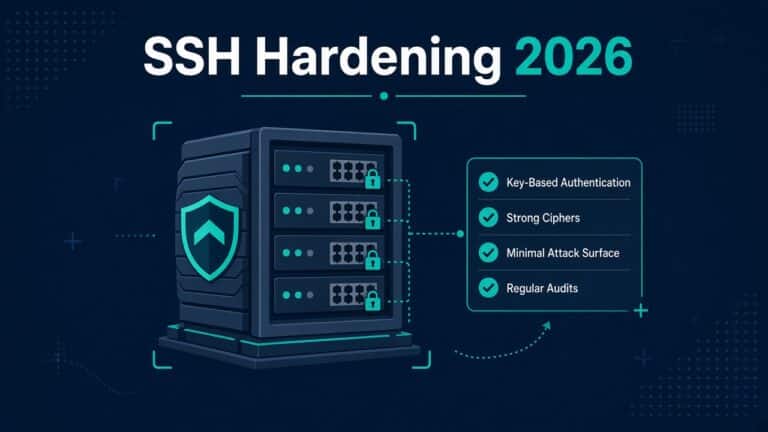
Write ugly-but-yours before copy-pasting mega playbooks. Concrete starter: first useful Ansible role. Harden SSH with intent — SSH hardening checklist.
Exit check: new VM → running service in under fifteen minutes, fully from Ansible, no manual apt install.
If stuck: reduce scope to one host and one role. Inventory reachability problems are SSH problems — fix trust before YAML.
Phase 2 — Docker as packaging (3–4 weeks)
Now that config drift hurts, containers make sense.
Focus on multi-stage Dockerfiles, Compose for local multi-service stacks, volumes vs bind mounts, non-root users, and memory limits. Do not start with Kubernetes here. K8s is orchestration; most people still need packaging solved first. Ops-shaped Compose habits: Docker Compose for ops.
Opinion: a junior who containerized a Java app, left the JDK and build cache in the final image, then wondered why scanners screamed, learns more from one multi-stage rewrite than from three K8s courses. Cut the image; keep the lesson.
Exit check: Compose stack (app + DB + reverse proxy) a teammate can bring up with one command and documented env vars.
Phase 3 — Terraform for the cloud shape (3–5 weeks)
Terraform after Ansible feels natural: Ansible shapes the OS; Terraform shapes the cloud around it.
Learn providers, resources, state (local first, then remote backend), modules for “VPC + bastion + one app subnet,” plan before apply religiously, and prevent_destroy where deletion hurts.
Pairing that works in small teams: Terraform for VPC, security groups, instances, load balancers, DNS. Ansible (or cloud-init + Ansible) for packages, users, app deploy, hardening. Trying to do SSH key distribution only in Terraform gets messy fast.
Exit check: destroy and recreate the lab from Terraform + Ansible with a documented rollback. If you cannot destroy it safely, you do not own it yet.
Phase 4 — CI/CD that is boring on purpose (3–4 weeks)
Pick one CI system and go deep: GitHub Actions, GitLab CI, or whatever work already runs.
Progression: lint/tests on PR → build image tagged with git SHA → push to registry → deploy staging → manual approval → production. Keep the first pipeline boring. Fancy matrix builds can wait. Broken deploys at 11pm do not wait.
Exit check: merge to main updates staging without you SSHing in for the happy path.
Tradeoff: fully automated prod deploys feel modern. On a small team with weak tests, a manual approval gate is wisdom, not cowardice.
Phase 5 — Kubernetes only when the problem appears
Add K8s when you have multiple services, need self-healing across nodes, or your employer already runs a cluster you must touch. Until then, Compose + systemd on well-built VMs is honest engineering.
If you learn K8s early anyway, still keep disk, OOM, and DNS triage sharp — those incidents do not disappear inside a cluster. They change costumes.
How to check you are not fooling yourself
# monthly honesty check — adjust to your stack
git log --oneline -20                    # are YOU shipping?
ansible-playbook --check ...             # drift visible?
docker compose config >/dev/null         # compose still valid?
terraform plan                           # surprise destroy?
Success: you can explain one production-shaped path: code → image/config → machine → health proof. If you can only recite tool logos, go back a phase.
If still stuck: pick one app you own (even a personal one). Drive it through phases 1–4 before opening another course tab.
Next action this week: put a VM rebuild checklist in Git and run Ansible against one lab host until the second run is clean.
A note on “DevOps” as a title vs a practice
Some companies rename every sysadmin to DevOps overnight and change nothing about hand-edited servers. Others never print the title but already run Ansible, image builds, and staged deploys. Optimize for the practice: reviewable changes, rebuildable environments, boring pipelines. The title usually follows.
When you interview, talk about a system you made rebuildable — not about a tool you installed once. One story with proof beats a slide of logos.
FAQ — real doubts
Do I need to quit sysadmin work to become DevOps?
No. The best transitions happen in the job: automate the painful weekly task, containerize the awkward app, put the VM build in Terraform. Titles lag skills.
What about Puppet/Chef/Salt?
If your workplace runs them, learn them. For greenfield learning in 2026 I still start most sysadmins on Ansible for speed to usefulness.
Certifications?
Useful doors sometimes. They are not a substitute for a public-ish lab repo that shows Ansible + Compose + a pipeline. Hire managers who can tell will look at both.
How long is this really?
Part-time, expect months, not a long weekend. The calendar above assumes evenings. Stretch phases rather than skipping exit checks.